Hypothesis
If light is most useful where the sun does not reach, then organisms in the open water column should glow far more often than coastal species living in daylight.
Biology investigation
How living things make their own light — and why, in the dark ocean, glowing is not a novelty. It is a way of life.
Scroll the investigationResearch question
Light is expensive. A cell that glows is spending energy it could have used to grow or flee. So if glowing is common, it must pay. This investigation asks where that payment is collected — and what the chemistry left us once we learned to steal it.
If light is most useful where the sun does not reach, then organisms in the open water column should glow far more often than coastal species living in daylight.
A literature synthesis. No new wet lab — instead, published video surveys (Martini & Haddock, 2017) plus reviews of the chemistry, from firefly ATP assays to GFP.
76%
of animals in the water column
Monterey Bay, surface to 4,000 m — Martini & Haddock, 2017.
90+
independent origins
Bioluminescence evolved again and again, not once from a common ancestor.
~80%
of luminous species are marine
On land it is rare. In the dark ocean, making light is ordinary.
Share of individuals (or species, for the coastal bar) able to produce light. Pelagic numbers from Martini & Haddock, 2017, Monterey Bay video surveys.
Finding: the hypothesis holds. In Monterey Bay, three-quarters of animals in the water column can make light. On the coast, glowing species are closer to two in a hundred. Light is not a carnival trick. In the dark, it is infrastructure.
The chemistry
A luciferin is oxidised. A luciferase makes that oxidation emit a photon instead of heat. The same job has been invented more than ninety times, with different molecules — which is why “luciferase” is a job title, not a family.
The reaction, in one line
Luciferin
the fuel
Oxygen
the oxidant
Oxyluciferin*
excited product
A photon
visible light
Luciferase is the enzyme that makes the oxidation fast enough to see. Fireflies also need ATP and magnesium. Some animals pack the ingredients into a photoprotein and fire it with a pulse of calcium.
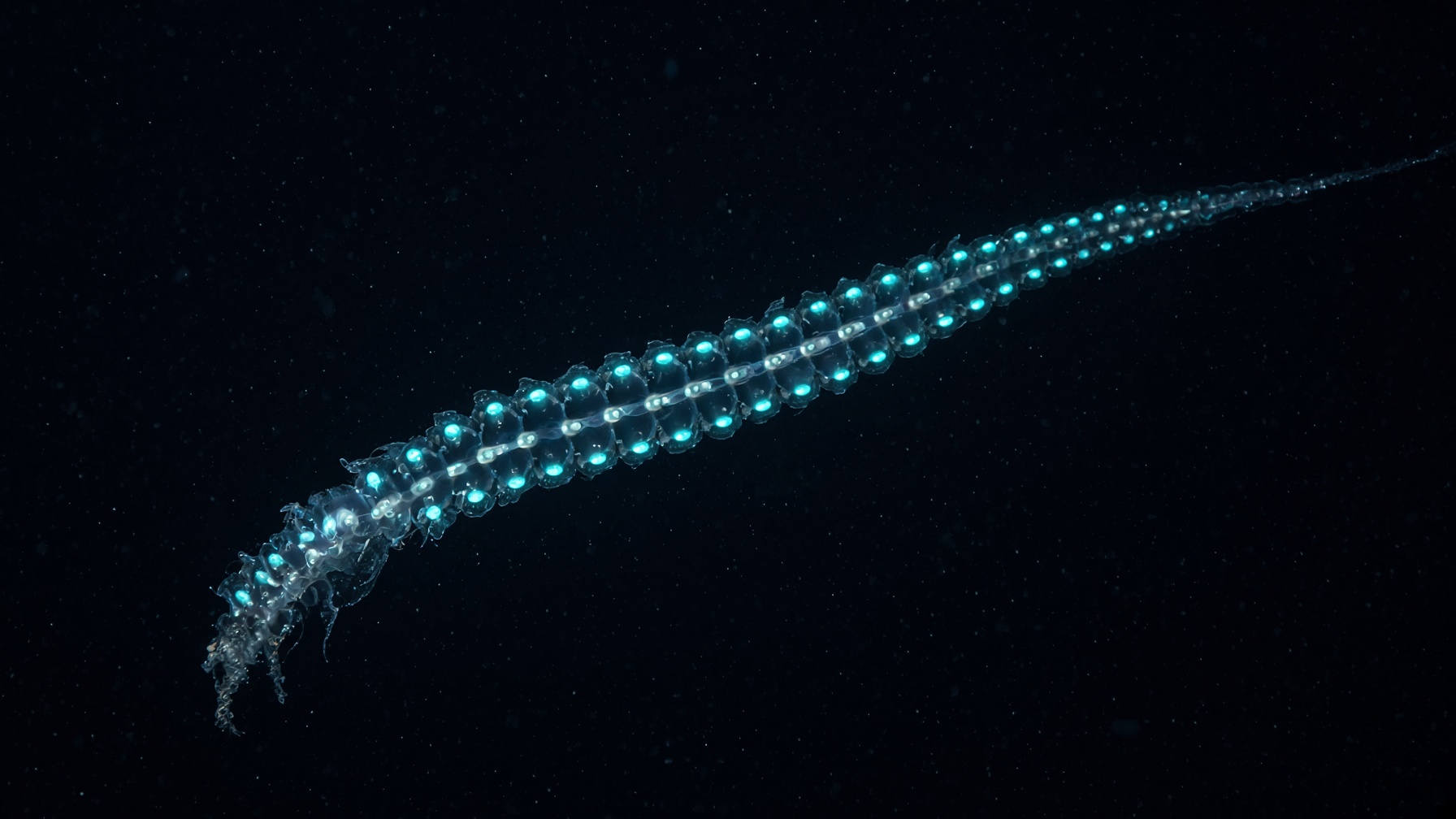
In the midnight zone, the primary visual stimulus is not the sun. It is other lives.
Four jobs for a photon
Counterillumination
From below, a swimmer is a dark cut-out against the dim sky. Rows of belly lights match that glow so the silhouette disappears. Bobtail squid and hatchetfish both use this trick.
Lures
An anglerfish’s esca is a fishing rod with a glowing bait. In some species the light is not the fish’s own chemistry at all — it is bacteria living in the lure.
Signals
Fireflies flash in species-specific codes. Females answer with a timed reply. Get the rhythm wrong and you are not a mate — you may be prey.
Alarms
A dinoflagellate sparkles when the water is disturbed. The flash can expose the predator to a larger hunter — a burglar alarm written in light.
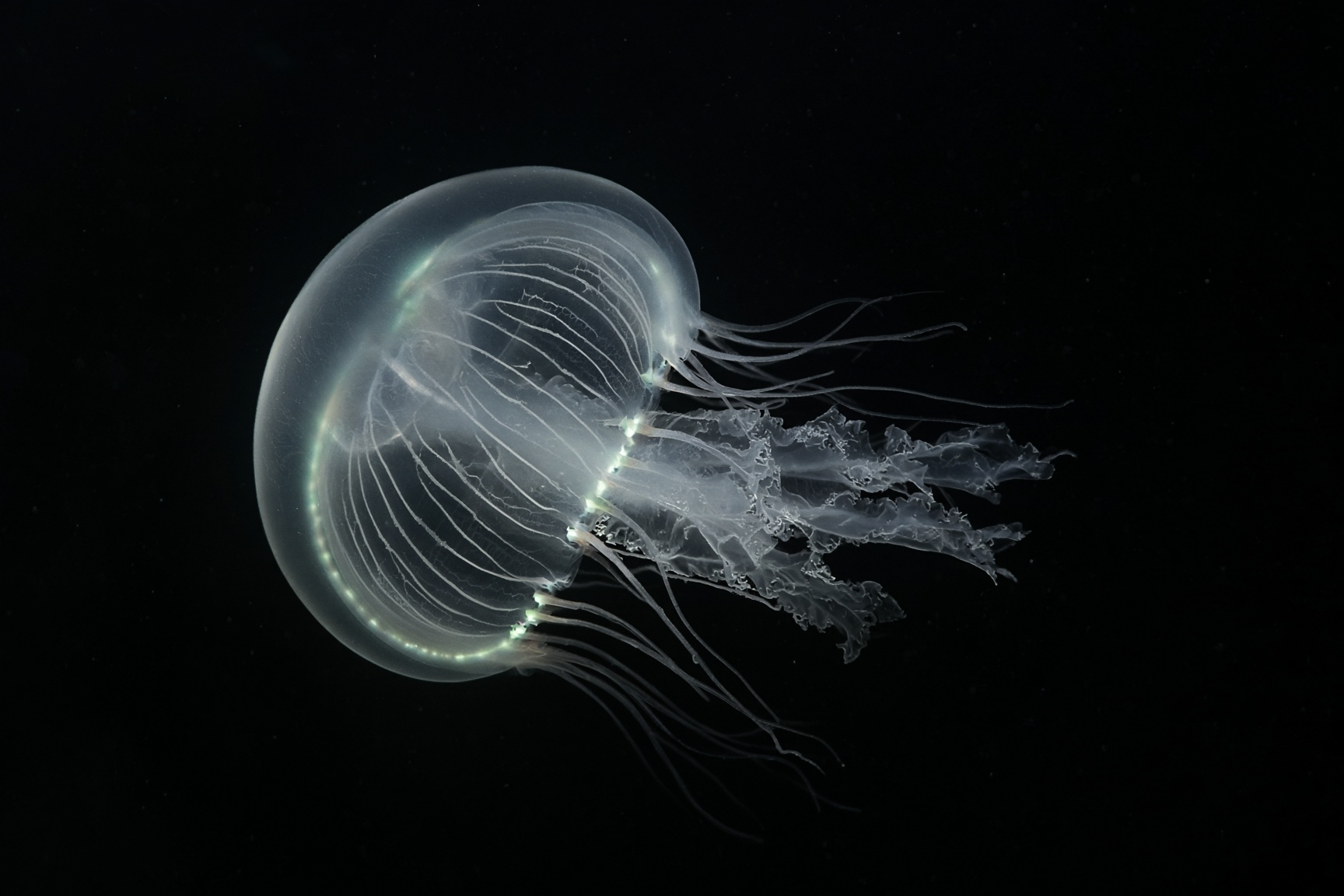
From sea to lab
Aequorea victoria gave us aequorin and GFP. Firefly luciferase gave us a way to count ATP. The same reaction that lets a squid vanish from below is now how researchers watch a protein move through a living cell. The investigation’s second finding: the chemistry is not only an ecological story. It is a toolkit.
Open the atlasConclusion
Independent origins, a handful of molecules, and a set of jobs — hide, hunt, talk, startle — explain why three-quarters of the animals in a dark water column glow, and why a coastal tidepool mostly does not. Meet six of the lanterns, then test yourself.
Use in class
Written so a teacher can run it without a slide deck. No accounts. The quiz holds a score on the device if you want an exit ticket.
01 · 8 min
Open with the research question and hypothesis. The three figures on the page are the claim the rest of the site has to earn.
02 · 10 min
Walk the luciferin reaction, then the Monterey Bay bars. The chart is the evidence, not decoration.
03 · 15 min
Pick three lanterns. Fireflies for signalling, the bobtail squid for borrowed bacteria, Aequorea for GFP.
04 · 10 min
Eight questions with explanations. Score stays on the device — useful as an exit ticket, not a high-stakes test.